Bank Statement Automation ROI: How Much Time and Money You'll Actually Save in 2026
Calculate real bank statement automation ROI: manual baselines vs automated time, error cost, staffing, and billable recovery—by small business, accountant, loan officer, and firm scale. See ranges, then plug in your own volumes.
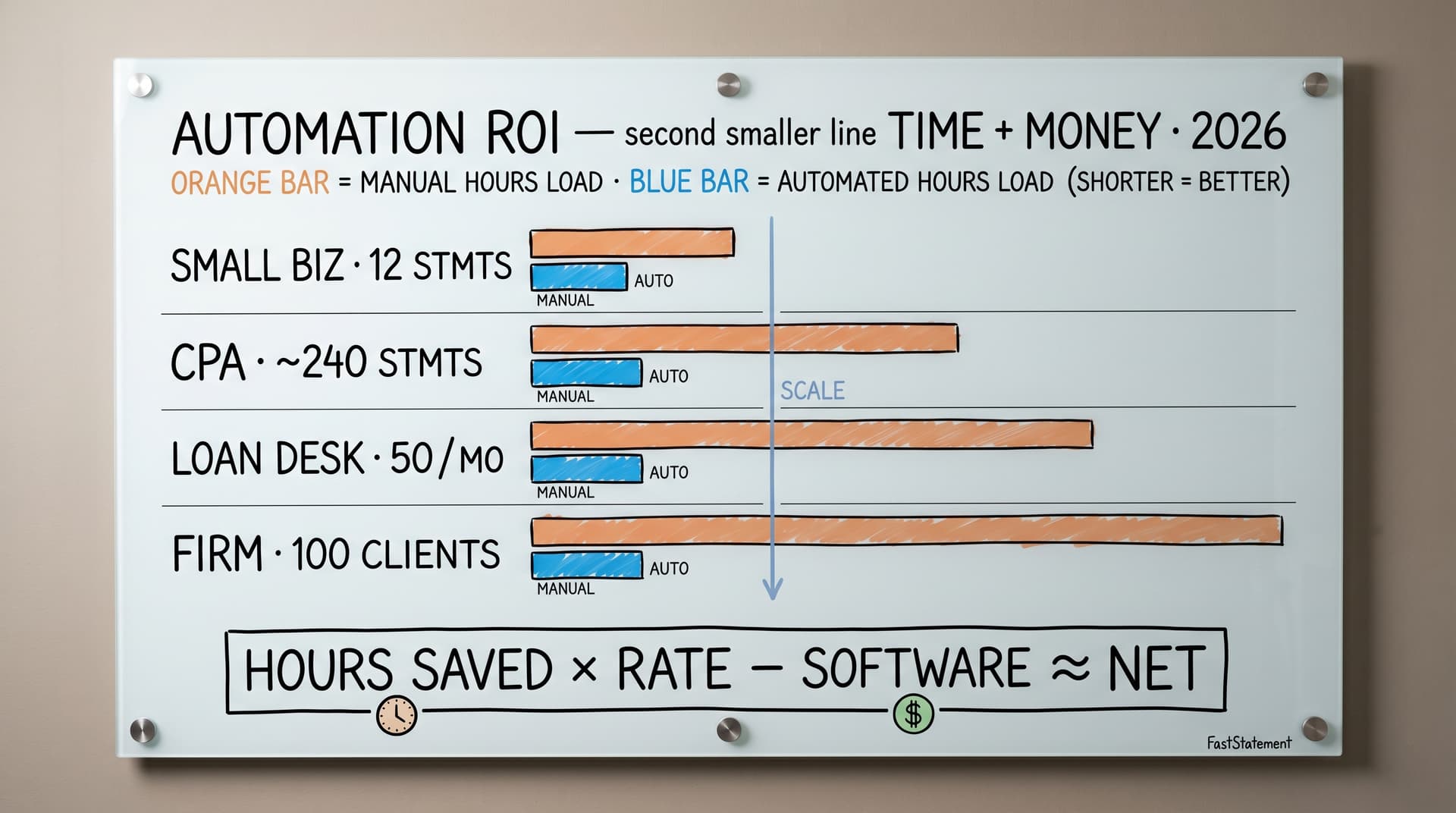
You have heard the promises: save hours on bank statements, automate bookkeeping, stop manual data entry. What is the real return? How much time do you actually claw back, and what does that translate to in dollars—especially once you count errors, rework, and staffing?
This guide walks through the math, split by role, volume, and opportunity cost. Whether you are a solo accountant with 15–20 clients, a small business with one operating account, or a loan desk touching dozens of packages a month, you can map your world onto one of the scenarios below—or jump to how to calculate your own ROI first.
How to read this post: Ranges are illustrative—they assume conservative manual touch times, a $50/hour opportunity-cost proxy unless noted otherwise, and automation aligned with accurate multi-engine OCR, batching, and review. Your firm’s reality will differ; treat tables as templates, not tax advice.
Pair this with common conversion mistakes so savings do not leak back out through process holes, and how to choose a converter if you are still comparing vendors.
The hidden cost of manual bank statement processing
Before estimating savings, anchor a baseline. Manual statement intake is never “free”—you pay in time, errors, rework, and forgone higher-value work.
Time cost per statement
Manual capture often lands around 30–60 minutes per statement end-to-end:
| Step | Typical band |
|---|---|
| Open PDF, navigate sections | 2–3 min |
| Read and interpret transactions | 8–15 min |
| Type into Excel / ledger | 15–35 min |
| Double-check totals and signs | 5–7 min |
At 12 statements per year per account, that is 6–12 hours annually for a single operating account before you add reviews or entity complexity.
Error cost
Manual typing produces predictable defect classes:
| Issue | Rough frequency |
|---|---|
| Amount typos | 1–2 / statement |
| Missed rows | 0–1 / statement |
| Wrong dates / descriptions | 1–2 / statement |
Across 2–5 issues per statement, cleanup often adds 10–20 minutes each—another 2–4 hours per account per year chasing ghosts.
Opportunity cost
The sting is what you cannot do while re-keying. At a $50/hour blended internal rate:
| Volume sketch | Order-of-magnitude annual opportunity burn |
|---|---|
| Small business: 12 statements | $300–$600 |
| Accountant: ~240 statements (20 clients × 12) | $6,000–$12,000 |
| Loan officer: heavy monthly intake | $2,500–$4,100+ (scaled below) |
Automation does not erase review—but it compresses transcribe/rekey work so those hours can move to advisory, underwriting judgment, or growth.
ROI scenario 1: Small business owner (12 statements a year)
Before automation (manual baseline)
| Component | Annual estimate |
|---|---|
| Statement processing | 6–12 h |
| Error correction | 2–4 h |
| Total time | 8–16 h |
| Opportunity cost @ $50/h | Processing $300–$600, errors $100–$200 → $400–$800 combined |
| Errors/year (12 × 2–5) | 24–60 |
After automation with FastStatement
Automated capture—especially with multi-pass OCR and quick validation—often fits ~45–110 seconds per statement for core extraction, plus ~2–5 minutes per statement for disciplined review (spot-checks, footer reconciliation).
| Component | Annual estimate |
|---|---|
| Processing | ~9–22 min total |
| Correction | ~24–70 min total |
| Total time | ~33–92 min (under 1.5 h) |
| Opportunity cost @ $50/h | Processing ~$8–$18, corrections ~$20–$58 → ~$28–$76 |
| Errors/year @ ~99.5% fidelity | ~0–12 realistic band (0–1 × 12 months) |
Small business ROI summary
| Metric | Manual | Automated | Savings |
|---|---|---|---|
| Annual time | 8–16 h | 33–92 min | ~7.4–15 h |
| Annual opportunity cost | $400–$800 | $28–$76 | ~$324–$724 |
| Errors / year | 24–60 | 0–12 | 12–48 fewer |
| Time reduction | — | — | ~96–97% on pure keying + heavy cleanup |
For many operators, subscription cost pays back inside the first busy month once you value time at market rates.
ROI scenario 2: Accountant with 20 clients (~240 statements)
Automation becomes a profit lever when volume compounds.
Before automation
| Component | Annual estimate |
|---|---|
| Processing (240 × 30–60 min) | 120–240 h |
| Error correction (240 × 10–20 min) | 40–80 h |
| Total | 160–320 h |
| Billable opportunity @ $50/h | Processing $6k–$12k, corrections $2k–$4k → $8k–$16k |
| Errors/year (240 × 2–5) | 480–1,200 |
Staffing lens: 160–320 hours of mechanical entry often implies 0.5–1.0 FTE of data work. At $2.5k–$5k/month, that is $30k–$60k/year loaded—money most practices would rather redeploy.
After automation with FastStatement
| Component | Annual estimate |
|---|---|
| Processing (~45–110 s × 240) | ~3–7 h |
| Correction (~2–5 min × 240) | ~8–20 h |
| Total | ~11–27 h |
| Billable opportunity @ $50/h | Processing ~$150–$350, corrections ~$400–$1k → ~$550–$1,350 |
| Errors (0–1 × 240 realistic band) | ~0–240 |
No dedicated data-entry lane required—existing staff absorb verification in fractional annual hours instead of multiple person-weeks.
Accountant ROI summary (~20 clients)
| Metric | Manual | Automated | Savings |
|---|---|---|---|
| Annual time | 160–320 h | 11–27 h | 133–293 h |
| Billable opportunity lost | $8k–$16k | $550–$1,350 | ~$6.65k–$14.65k recovered |
| Errors / year | 480–1,200 | 0–240 | Fewer by hundreds |
| Staffing (illustrative FTE) | ~$30k–$60k | $0 dedicated | Up to $30k–$60k avoided/redeployed |
| Time reduction | — | — | ~96–97% |
Combined story: recovered billable potential plus staffing elasticity often lands in the tens of thousands of dollars annually for this footprint—exact mix depends on whether you were hiring ahead of the curve or eating overtime internally.
ROI scenario 3: Loan officer (~50 applications monthly)
Here speed is revenue—cycle time influences pull-through and referral velocity.
Before automation
| Factor | Estimate |
|---|---|
| Manual statement work / application | 30–60 min |
| 50 apps/month → monthly | 25–50 h → 300–600 h/year |
| Opportunity @ $50/h | ~$15k–$30k/year |
| Operational drag | 3–5-day turnarounds cap throughput; model assumes 10–20% leakage from slow response |
After automation
| Factor | Estimate |
|---|---|
| Automated conversion + light review | ~2–4 min/application |
| 50 apps → ~1.7–3.3 h/month (~20–40 h/year) | |
| Opportunity cost | ~$1,020–$1,980/year |
| Capacity story | Same-day / next-day turnaround realistic; model room for +20–30 incremental apps/month from freed calendar |
Loan officer ROI summary
| Metric | Manual | Automated | Delta |
|---|---|---|---|
| Annual time | 300–600 h | 20–40 h | 260–560 h saved |
| Annual time cost @ $50/h | $15k–$30k | $1,020–$1,980 | ~$13k–$28k saved |
| Practical throughput | ~50/mo | ~70–80 plausible | +20–30 apps/mo |
| Turnaround | 3–5 biz days | hours–1 day class | Much faster |
ROI shows up as hours returned and top-line capacity, not only softer “efficiency” bullets.
ROI scenario 4: Bookkeeping firm (~100 clients)
Before automation
| Component | Annual estimate |
|---|---|
| Processing (100 × 12 × 30–60 min) | 600–1,200 h |
| Corrections | 200–400 h |
| Total | 800–1,600 h |
Staffing: 2–4 FTE data-entry lanes at ~$28.8k–$57.6k each → $57.6k–$230.4k/year.
Senior opportunity cost: if partners review or firefight, $40k–$80k of theoretically billable attention tied to mechanical workflows @ $50/h illustrative proxy.
After automation
| Component | Annual estimate |
|---|---|
| Processing (~45–110 s × 1,200 stmts) | ~15–37 h |
| Corrections | ~40–100 h |
| Total | ~55–137 h |
No dedicated entry pod required—core team absorbs QA. Staff savings potential: $57.6k–$230.4k redeployed or avoided. Senior drag falls toward ~$2,750–$6,850/year on the same proxy math.
Firm ROI summary (100 clients)
| Metric | Manual | Automated | Savings |
|---|---|---|---|
| Annual time | 800–1,600 h | 55–137 h | 663–1,463 h |
| Illustrative staff cost | $57.6k–$230.4k | — | $57.6k–$230.4k flex |
| Senior billable drag | $40k–$80k | ~$2.75k–$6.85k | ~$33k–$73k recovered |
| Indicative total upside range | — | — | ~$90k–$303k+ all-in (highly model-dependent) |
Payback, at this scale, is often days once onboarding completes—not quarters.
Why FastStatement pushes ROI higher
Not every converter produces the same economics. A few product choices directly move the rows above:
| Capability | ROI lever |
|---|---|
| Multi-engine OCR + fallback | Lands ~99.5% accuracy on many digital PDFs → 0–1 issues/statement vs 2–5 manual/OCR-light |
| Built-in PDF editor + redaction | Fix source truth before extraction; avoid paying for a separate Acrobat-class seat for redlines |
| Bookkeeping layer (categorization, duplicate detection, reconciliation scaffolding) | Competitors sometimes bill $99+/mo extra for “analysis” modules—you fold more into core workflow |
| Batch processing | Compress wall-clock for tens of PDFs toward one session instead of serial babysitting |
| Client-side extraction where applicable | Instant exports without queue roulette; fewer third-party copies for privacy narratives |
How to calculate your own ROI
Use this repeatable framework:
- Count annual statements across accounts and clients.
- Estimate manual minutes per statement (start with 30–60 if unsure).
- Estimate automated minutes (often ~1–2 min machine + 2–5 min review early on).
- Subtract → annual hours saved.
- Multiply by your effective hourly rate ($50 default sanity check).
- Add one-off savings: redundant OCR subscriptions, PDF tooling, avoided hires.
- Subtract FastStatement pricing → net ROI.
Most teams that process more than a handful of statements monthly see payback quickly; your exact crossing point depends on plan tier and how aggressively you batch.
Assumptions checkpoint (sanity-check before you stake a forecast)
| Assumption | Why it matters |
|---|---|
| Fully loaded hourly rate | Partner time != staff time—swap $50 with your realization or replacement cost. |
| Statements include scans | Scanned PDFs inflate review minutes; digital-native PDFs trend toward the fast end of ranges. |
| Review survives automation | We still budget minutes per statement for reconciliation IQ—the tables are not “zero touch.” |
| Staff savings are strategic | Avoided hires show up as capacity, not always immediate cash unless you defer recruiting. |
| Loan throughput uplift | +20–30 apps/month requires sales/marketing funnel alignment—not clock time alone. |
Rename line items on your internal P&L accordingly and the ROI story stays defensible under finance scrutiny.
Real-world calibration sketches
| Profile | Volume | Manual $ @ $50/h | Automated $ (illustrative) | Net story |
|---|---|---|---|---|
| Freelance bookkeeper | 10 clients (~120 stmts) | ~$3k–$6k drag | ~$75–$185 | ~$2.8k–$5.8k/year |
| CFO, 5 accounts (~60 stmts) | 60 | ~$750–$1,500 @ $25/h internal | Under ~$50–$100 class | ~$730–$1,450 |
| Firm ~75 clients (~900 stmts) | 900 | Heavy staffing + review | Automation-first ops | Often six figures when hiring + partner time both counted |
Extra ROI people forget to invoice
- Faster client delivery → retention + referrals
- Elastic scale without proportional hiring
- Less burnout from robotic typing
- Cleaner audit trails when extraction + review are templated
- Competitive positioning as a tech-forward shop—worth something in RFPs even if it is hard to dollarize
Conclusion: Manual entry is the pricey line item
Paper checks used to be normal—until the cost of inertia exceeded the cost of change. Manual statement entry is the same class of drag in 2026:
- Solo businesses still save hundreds of opportunity dollars without heroic volumes.
- Accountants and bookkeepers reclaim tens to hundreds of hours of capacity.
- Larger firms unlock six-figure combinations of salary redeployment and senior time returned.
FastStatement concentrates those savings through accurate OCR, in-flow editing, bookkeeping-friendly tooling, batch throughput, and privacy-conscious processing.
Next step: Try it free (first page without signup), run your next few statements, and plug your actual stopwatch numbers into the worksheet above—nothing beats empirical minutes from your own PDFs.
Related: Best bank statement converters comparison (2026) · Month-end statement pipeline · Pricing (machine-readable)*